

Ok, here’s a graph about sex.
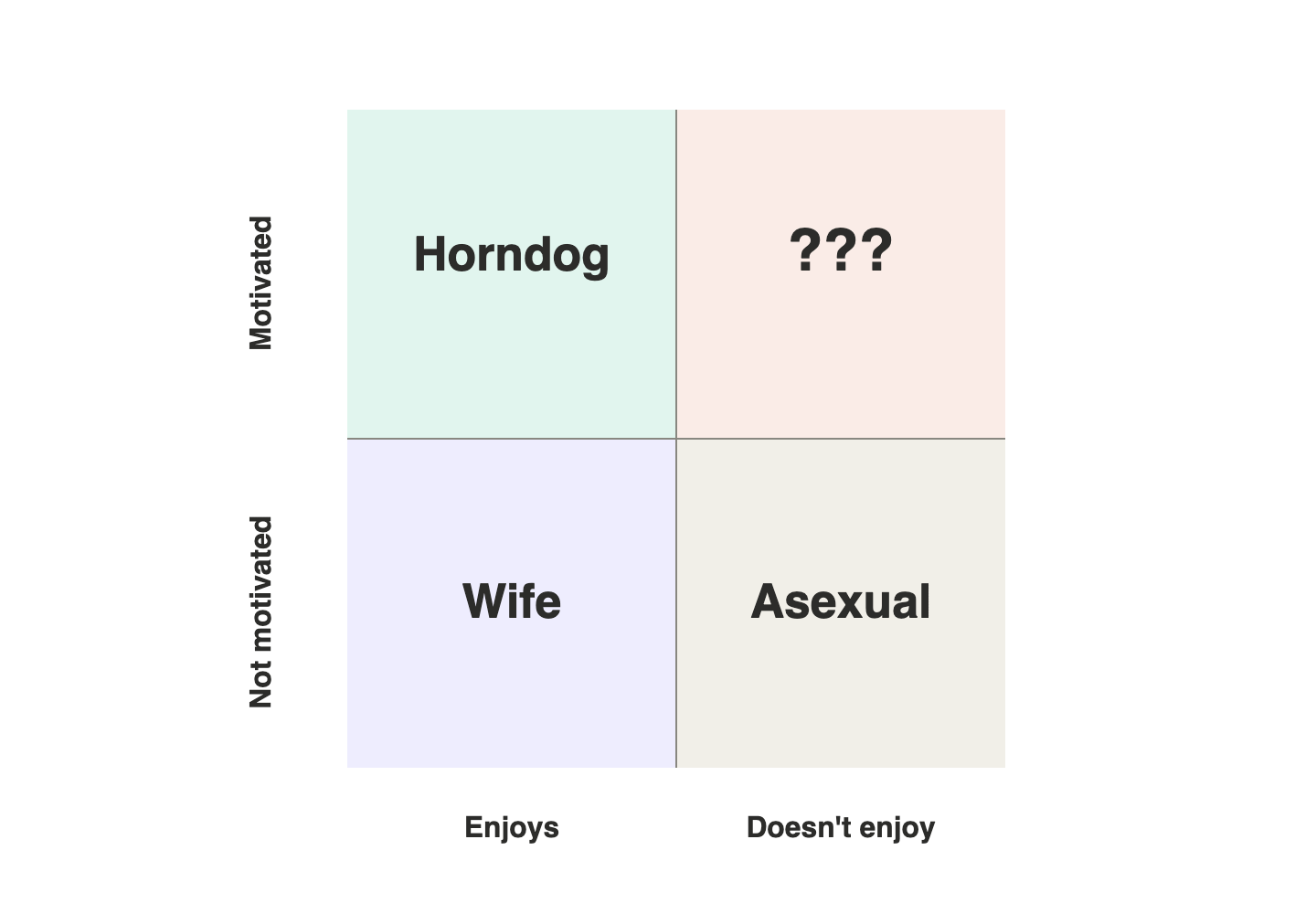
Two of these squares seem obvious and basically need no explaining. In the top left quadrant you got the Horndogs who have a very high drive to have sex, and enjoy sex a lot when they get it. And in the bottom right you have the Asexuals who don’t feel much motivation to have sex, and when they do, don’t really get what all the fuss is about. This makes sense and no one is confused by these people, and they don’t find their own behavior all that confusing.
We might describe the person in the bottom right (jokingly referred to here as “Wife” since this is a common description of female sex drive) as having responsive desire -- they aren’t very motivated to seek out sex, but when it happens, they like it. They might even like it a lot, and have the thought: “Wow I forgot this is so great! Why don’t I do this more often?” or something.
But the last category is so unfamiliar that there’s no good name for it. This person is very driven to seek out sex but doesn’t seem to enjoy it very much when they do have it. If such a person exists, they might have thoughts like, “Why am I doing this?” or “I wish I could spend more time on [thing they actually enjoy] instead of all this time I spend pursuing sex.”
The last two categories might seem confusing because many people intuitively think of desire and motivation as two elements of the same “drive” system. It seems like if someone enjoys something then they would be motivated to pursue it, and if they don’t enjoy it then they wouldn’t spend any time and energy seeking it out. As you can see in Figure 1, however, there’s no reason these can’t be two entirely separate parameters. They might be related, or they might be totally independent.
It might be the case that with some drives pleasure and motivation aren’t tightly coupled, but for other drives they always go together. We expect breathing, for example, to be both pleasurable and highly motivating for almost everyone. On the other hand, someone with an addiction might be very driven to use drugs but experience very little pleasure when they use them.
Perhaps for some drives pleasure and drive aren’t tightly correlated, but people don’t cleanly fall into each quadrant. Some drives may be like variations of Fig. 1, where most people fall into two or three categories, and in others there are people in all four categories.
To make matters more complicated, it seems likely that context plays a role as well. There may be a relative increase in the pleasure of satisfying a drive if the drive has been unsatisfied for longer, or is more important for survival, or some other reason, and that increase or decrease in pleasure may also be different from person to person.
The good news is that we can do a study. We’ve put together a survey to test out how closely tied pleasure and motivation are for a variety of drives. You can take it here, and we’ll post the results soon!
Isn't this the gooner archetype?
I think that unnamed category is much more common than we might think! I have talked to quite a few men and some women who frequently seek out sex for various reasons but rarely enjoy it. Sometimes it’s because they think that’s what they’re “supposed” to do (in order to be manly or something). Sometimes it’s to accomplish some other goal (reassurance of their attractiveness, to please their partner, to manipulate or get revenge on someone, etc). I think there is SOME cultural awareness of women who do this, but it seems that the men in this category often hide it because they’re afraid they won’t be believed or that they will be seen as broken somehow.